
Space is Big
The late, great Douglas Adams put it like this:
“Space is big. Really big. You just won’t believe how vastly hugely mindbogglingly big it is...”
Thus began the The Hitchhikers’ Guide to the Galaxy – voiced in Peter Jones’ wonderful deadpan for the original 1974 BBC Radio 4 series:
‘…I mean you may think it’s a long way down the road to the chemist, but that’s just peanuts to space. Listen… and so on‘.

An item in this week’s New Scientist gives you another way of looking at this. Apparently, cosmologists are excited by the discovery (by an amateur astronomer, yay!) of the nearest supernova to us that anyone has seen for years. It’s billed on the front cover as BACKYARD SUPERNOVA. They say this is going to give us a ringside seat as the explosion develops over the next months and years so that we can learn all sorts of new things.
But pause for a moment to look at what they mean by ‘nearby’, and ‘BACKYARD’. This burst of light is actually coming from an exploding star in a galaxy, the article tells us, not merely ‘far far away’, but 21 million light years away,
That means the light arriving in our telescopes today must have set off on its journey 21 million years ago – so the event we are witnessing from our ‘ringside seat’ actually happened 21 million years ago. Which, I see from Wikipedia when I look it up, was the Serravalian age of the Miocene on Earth, when a little monkey-like creature, Anoiapithecus, one of the earliest hominids, was living in what is now Spain.
One of the science facts I remember from childhood is that light travels at a hundred and eighty six thousand miles a second. So the light from that explosion, which outshines the light of the entire galaxy it comes from (galaxies are big, bright things – think Milky Way with its one hundred thousand million stars – Oh no, perhaps don’t) the light from that explosion has been travelling that distance – most of the way to the Moon – every second for all of that time. And although the article tells us in passing that astronomers see thousands of supernovae every year (I did go back and check this) this one is extraordinarily near to us. Is your mind boggling yet? Mine certainly is.
Let’s return to Douglas Adams’ Hitchhikers’ Guide to put it in a nutshell:
‘The simple truth is that interstellar distances will not fit in the human imagination’
Quite.
Which brings me to a thought of mine own which I think may be worth sharing.
My generation grew up during the postwar years full of optimism about scientific advances and in particular the much-heralded era of space travel.

In the early 1950s the nearest thing to a comic our parents allowed us to read was the Eagle. My favourite character was Dan Dare, Pilot of the Future, rocketing about in his space ship and combatting the evil Mekon, a green, disembodied head, who commanded his alien space-squadrons, crewed by evil ‘Treens’ (also green), from the control room of his flagship while floating about on something a bit like an avocado dish. Wonderful stuff.
When the family went to America in 1954 I was engrossed in a radio series called ‘Journey into Space’. The plucky heroes of which had just arrived on Mars when we had to head for Southampton and the Queen Mary. And we left on the very morning after the episode when they discovered they were not alone. I had asked my friend Derek to promise to tell me what happened. But he never did. (I still don’t know.)
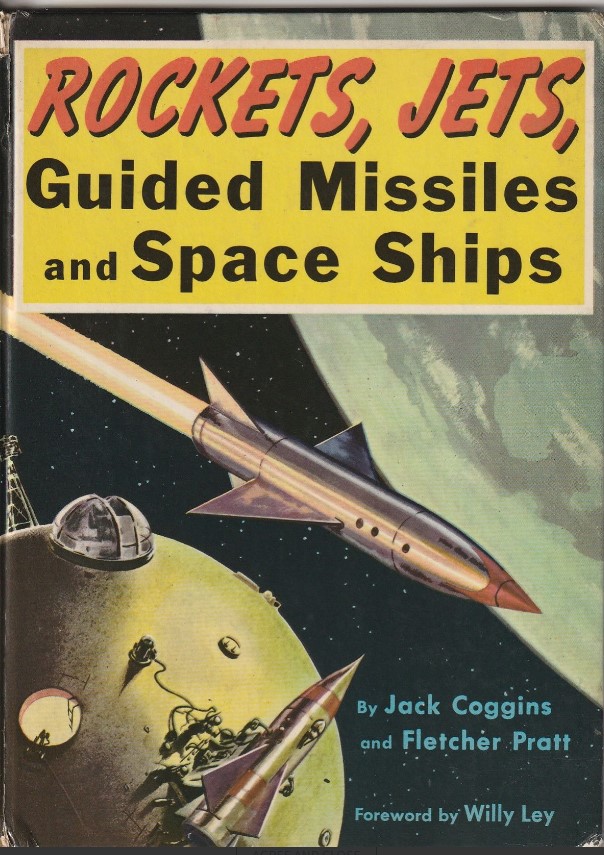
After arriving in America one of my favourite presents, if not the favourite present, was a book called Rockets, Jets, Guided Missiles and SpaceShips. I came back to it over and over again for years, and kept making feeble attempts to draw my own space ships. I was pretty sure I still had the book somewhere in the loft, but when I looked just now it seems to have gone. So this image, which must be of the original edition I had, is from the web..
Then of course we grew up through the whole Sputnik, Moon landings, Space Shuttle, saga which gripped our generation and continues today with various tycoons taking joy-rides into ‘space’ and Elon Musk seriously suggesting he would like to take a trip to Mars.
But behind all this it seems to me there has been a basic assumption that we are on the threshold of something called the ‘Space Age’, when mankind will have learned to travel between the stars. And so we have people discussing – not least in New Scientist – various technologies for powering a space craft to another star (and then slowing it down again when it gets there don’t forget) and different ways in which human passengers might be accommodated, preserved, entertained even, for the vast expanses of time required to make the journey. Here is such a discussion.
Now the realisation that has only recently occurred to me, and which I would love to hear a convincing reason to doubt because it is so disillusioning, is this:
Quite simply, everything is so mind-bogglingly far apart in space that even if we did make the colossal effort, investment, human sacrifice, etc. that would be required to send an expedition to, say, proxima-centauri, the nearest star – a mere 4.24 light years away – we would find ourselves when we got there just as far away from everywhere else as we were when we started.
All the other stars (don’t even think about all the other galaxies!) would be no closer to us than they were when we left Earth. I don’t know about you, but after a lifetime of what I now realise are unrealistic imaginings, I find that a thoroughly sobering thought.
But this is surely yet another reason to use our industry, enterprise, human genius, and all the rest of it, to look after the world we’ve got before it’s too late. The idea, which you do see seriously mooted, that we might somehow survive by moving somewhere else, ain’t going to happen, even if it wouldn’t have been a nightmare for all the other obvious reasons..
I once explained to a very young grandson that when I was his age we didn’t know whether there were men on Mars. His reply was disarmingly sensible, ‘But you must have known it was very unlikely’.
I’m afraid it’s time to grow up.


A tribute to Robert M. Pirsig
Talking in some depth about things that seem important – by J A R Willis
This article appeared in the December 2000 issue of Medical Humanities in the series Medicine through the Novel. It is repeated here as a tribute to one of my greatest inspirations – Robert M. Pirsig – who died two days ago (24 April 2017)

‘Unless you are fond of hollering you don’t make great conversations on a running cycle. Instead you spend your time being aware of things and meditating on them. On sights and sounds, on the mood of the weather and things remembered, on the machine and the countryside you’re in, thinking about things at great leisure and length without being hurried and without feeling that you are losing time.’ (p 17 of 416)
The gentle voice is incredibly familiar, heard now for the third time, a voice that seems to have got itself into my deepest being. Read more…
 Generally Speaking